
- Key Takeaways
- The ECM Tuning Process
- Potential Performance Gains
- Inherent Operational Risks
- The Compliance Tightrope
- Stock vs. Aftermarket Maps
- Choosing A Tuning Partner
- Select a reputable, experienced shop like Coppertop Truck Repair that understands heavy-duty diagnostics and compliance.
- Verify that your tuning partner uses advanced tuning technology and offers custom ecm solutions for your fleet.
- Ensure the shop prioritizes durability, uptime, and regulatory compliance in every tuning project.
- Encourage Alberta fleet managers and owner-operators to consult Coppertop’s team for expert advice before modifying ecm settings.
- Conclusion
- Frequently Asked Questions
- What is ECM tuning, and how does it work?
- How much performance can I gain from ECM tuning?
- What are the main risks of ECM tuning?
- Is ECM tuning legal in my region?
- What’s the difference between stock and aftermarket maps?
- How do I choose a reputable tuning partner?
- Do I need supporting mods for ECM tuning?
Key Takeaways
- Use a performance ECM tuning workflow from diagnostics to final validation to safeguard safety, compliance, and engine longevity. Be sure to always back up your original calibration and verify your ECM is compatible prior to any modification.
- Professional-grade tools and specialized software read and adjust engine maps precisely. Focus on fuel timing, boost, throttle response, and air-fuel ratios to meet duty cycles and fleet objectives.
- Verify each tune with controlled road testing and live data to ensure actual increases in power, efficiency, and drivability. Benchmark results versus baseline and log all changes for maintenance and audits.
- Take it for a spin and experience the thrill of performance ECM tuning. Do not disable DPF, EGR, or SCR and ensure you keep a detailed record to prove compliance and protect resale value.
- Control risk by picking moderate, proven tunes and keeping an eye on EGTs, coolant temps and oil quality. Keep injector, turbo and drivetrain stress from becoming failures by scheduling regular inspections.
- Team up with a trusted heavy-duty expert providing custom, compliant calibrations and next-level diagnostics. Focus on durability, uptime, and regulatory considerations when choosing a tuner.
Performance ECM tuning refers to the act of updating an engine control module’s software to optimize fuel maps, ignition timing, throttle response, and boost control in order to increase power and efficiency. Performance ECM tuning tuners make proven adjustments to key tables and limits to match parts like intakes, exhausts, and turbo upgrades, and typically see 5 to 20 percent horsepower gains, smooth torque curves, and more stable drivability. Secure outcomes depend on datalogs, knock control, air-fuel ratios, and heat management. Many users combine tuning with higher octane, colder plugs, or better intercoolers to keep temperatures and knock under control. Emissions and warranty rules change from region to region and brand to brand, so it’s important to be compliant. The paragraphs below address techniques, hazards, software, and understanding actual dyno data.
The ECM Tuning Process
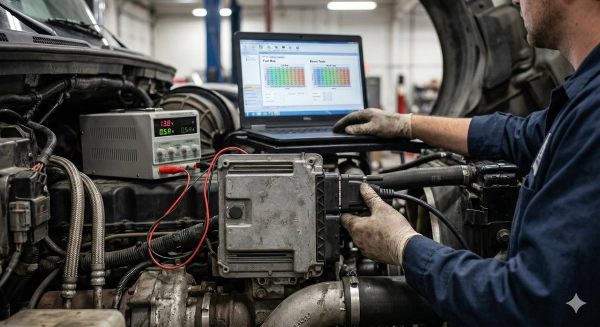
An organized process opens safe gains while protecting emissions, uptime and cost.
- Diagnostics and intake: Confirm symptoms like poor fuel efficiency, gather fault codes, and review service history.
- Module access and backup: Connect, identify software, and save stock calibration.
- Baseline assessment: Log horsepower, torque, fuel use, EGR duty, and boost.
- Parameter strategy: define goals—better mileage, more pull, or both.
- Map edits: Adjust fuel, timing, boost, throttle, limiters, and EGR tables.
- Flash and integrity checks.
- Road test and validate against baseline. Every stage uses pro-grade tools and puts safety, emissions regulations, and engine longevity front and center.
1. Accessing The Module
Utilize an OEM level interface and stable power, including a battery maintainer, to prevent voltage dips during communication.
Verify ECM make, model and calibration ID so tuning files and protocols align with the truck’s platform and aftertreatment.
Make a complete backup of the original calibration. Archive it with the VIN, date, and notes so you can roll back quickly if necessary.
2. Reading The Map
Pull your existing map and examine fuel delivery, ignition timing, turbo boost, EGR flow targets, and torque limits.
Analyze live sensors and logs across loads: intake air temperature, manifold pressure, lambda, NOx, and exhaust gas temperature.
Measure baseline power, torque, and fuel burn in liters per 100 kilometers, along with idle fuel rate and throttle response time.
By duty cycle—long-haul, regional or off-road—list safe-to-adjust tables so changes fit real work.
3. Modifying Parameters
Target fuel maps, boost pressure, and injector timing, then finalize throttle response and torque management to load profiles.
Manage emissions by tuning EGR rates and the air-fuel mix, reducing NOx and aiding compliance.
For fleets pursuing savings, target steady-state fuel trims because even small mileage increases can save thousands a year.
Forget canned tunes. Create personalized ECMs related to gear ratios, terrain, and trailer weight.
4. Writing The New Map
Flash the updated map with secure software, validate checksums, and align hardware boundaries to table values so protection remains intact.
Monitor for write errors, record the session, and save the new file with an obvious changelog for servicing down the line.
5. Verifying The Changes
Road test under actual loads, monitor live data, and check for codes or strange sensor trends.
Contrast post-tune fuel consumption, throttle response, horsepower, EGR activity, and temperature against baseline. Fuel economy gains aren’t unusual, emissions can go down, and engines often run smoother when maps suit the task. If your truck has weak pull or poor mileage, ECM tuning can tune it back and often increase it.
Potential Performance Gains

We see obvious performance improvements in power, efficiency, and everyday driveability. It depends on the engine, the route profile, the payload, and how good the tune is.
- Horsepower up by 15–30% with a sound performance tune
- Higher torque for towing and steep grades
- Fuel efficiency increases of 5 to 10 percent and frequently 10 to 20 percent MPG on certain routes.
- Lower DEF use and fewer DPF regens
- Cooler temps, less stress, and longer service life
- Better throttle response and smoother shifts
- Costs drop with less fuel burn and fewer regens
Power
A well-done tune can typically boost horsepower by 15 to 30 percent and add healthy mid-range torque. Gains beyond that range require hardware modifications such as upgraded turbos, injectors, or cooling. Power output correlates with engine model, existing bolt-ons, and how aggressively the calibration pushes timing, boost, and fuel limits.
Additional power aids trucks in merging quicker, maintaining speed on inclines and towing heavy trailers with fewer down shifts. On a 330 kW engine, that 20% leap can contribute a roughly 65 kW addition, which cuts down on the time it takes to reach highway speed and makes lane changes under load more assertive.
Results differ. Older, tight airflow or weak cooling engines have smaller jumps than modern, efficient turbo platforms. Screaming tunes increase cylinder pressures and exhaust gas temperatures, which can stress pistons, rods, clutches, and torque converters. Design for exhaust gas temperature monitoring, sound cooling, and conservative torque limits to save driveline components.
Efficiency
Tuning can reduce fuel consumption by 5 to 10 percent with accurately timed injections, pressure control to the rail, and leaner mixtures. Several fleets further describe 10 to 20 percent MPG improvements on long, constant routes, particularly when load and terrain remain unchanged.
Economy-focused maps reduce pumping losses, limit wasted enrichment and keep the engine in its optimal brake-specific fuel consumption range. They can decrease DEF consumption and DPF regens by enhancing combustion and reducing soot production.
Compare fuel burn pre and post with the same route, payload, and weather. Measure in liters per 100 kilometers, then convert to miles per gallon if you prefer. Hard power maps can potentially burn more fuel under load.
Drivability
Well-crafted tuning hones throttle response, trims turbo lag, and smooths shift events. This comes in handy in stop-and-go traffic, city work, and tight docks.
Calibrations can be tailored to hilly roads, heavy or light loads, and driver styles. Predictable is more important than peak for both uptime and safety. Maintain linear torque delivery, handle EGTs, and retain engine braking logic.
Inherent Operational Risks
ECM tuning changes how the engine manages air, fuel, spark, and emissions. Inherent operational risks exist before any controls or safeguards, and they rise with complex systems, third-party tools, and high transaction volumes like frequent calibration writes. Assess risk with a three by three matrix that compares likelihood and impact: low, medium, and high. Use key risk indicators to track early signs of loss, since teams may rate the same risk differently.
Engine Stress
Punk rock songs increase cylinder pressure and peak firing loads, straining rods, pistons, rings, head gaskets and crank bearings outside their engineering window. A little more boost and timing can raise combustion temperatures, which decreases part life even if the car drives great.
Additional boost and fueling accelerate wear on piston ring lands, turbo thrust bearings, and main and rod bearings. Small-frame turbos surge or overspeed at high boost targets and direct injection pumps can starve with sustained loads in hot climates.
Use conservative, flight-proven maps with data from engines, fuels, and altitudes. For staged upgrades, test airflow and lambda under load to find the sweet spot between power and life.
Track KRIs: oil quality and pressure, coolant and intake-air temperatures, and exhaust gas temperatures. The goal is to maintain stable EGTs under 850 to 900 degrees Celsius for many turbo petrol engines, while diesels often operate at lower temperatures. Include wideband O2 and EGT probes to catch unsafe trends early.
Component Failure
Bad calibrations can kill injectors with long pulse widths, clog DPFs with excess soot, and foul O2/NOx sensors. Mismatched torque maps can instigate constant DPF regens or limp modes.
Power jumps can overload clutch torque ratings, shear CV joints, or overheat automatic transmissions. A torque gain of 20 to 30 percent might push a gearbox from medium to high impact on a 3×3 matrix.
Choose quality parts: fuel filters rated for fine micron, OE or proven injectors, and high-temp plugs. Check turbo end play, intercooler boots, and DP pressure lines after tuning.
Fix warning lights, knock, smoke or strange whine immediately. Postponed fixes convert a low probability occurrence into a high consequence malfunction.
Warranty Void
Most manufacturers void engine and emissions warranty if unauthorized tuning is detected, even when hardware is stock. Insurers in certain jurisdictions might contest claims after such non-disclosed performance modifications.
Inherent operational risks on flash, check warranty terms and local insurance policy wording before any flash. Save invoices, tune versions, datalogs, and installer credentials to mitigate claims and demonstrate reasonable care.
Out-of-pocket costs can be high. Turbochargers, high-pressure pumps, or particulate filters often run into thousands in EUR or USD.
The Compliance Tightrope
Performance ECM tuning has to increase torque and reduce fuel burn without tripping emissions or safety regulations. Out of compliance tunes are a recipe for failed tests, roadside downtime and fines. More usable power, with aftertreatment intact, logged and verifiable.
Emissions Standards
Heavy-duty diesels encounter federal EPA thresholds for NOx and particulate mass, while provinces and states establish inspection programs and opacity standards. Certain counties include local tests for diesels. Emissions tampering is illegal under the U.S. Clean Air Act and is punishable by fines of more than $10,000 per violation.
ECM changes affect exhaust temperature, fueling, and air flow, which can assist or hinder the DPF, EGR, and SCR. Too much fuel increases the soot rate and clogs the DPF. Low exhaust heat blocks regeneration. Aggressive timing can spike NOx and overwhelm the SCR or starve it of ammonia by changing dosing windows. EGR flow targets that are too low increase NOx, while too high can increase soot and heat.
It’s illegal and detrimental to air quality to disable DPF, EGR, or SCR. It sets off fault codes, limp modes, and smoke. Only compliant tunes keep monitors primed, support full regen logic, and pass OBD‑based and opacity tests. Request lab or field data at sea level and elevation. Climate and elevation affect backpressure and catalyst light‑off.
Roadside Inspections
Leave all emissions systems in place after tuning for random CVIP and roadside checks. Inspectors check DPF status, EGR command and feedback, visible smoke, SCR readiness, DEF quality, and check engine or MIL status. Scan for fault codes and tamper flags.
Keep calibration IDs, change logs, and software versions stored in the cab and online. Bring along dyno sheets, smokereads, and any opacity or lab results. Out-of-compliance tunes can translate into immediate out-of-service orders, citations, and lost delivery timeslots, towing fees, and lost contracts. The Compliance Tightrope Alberta fleet managers should set compliance rules, audit vendors, and standardize calibrations for predictable uptime.
Resale Value
Trucks with undocumented tunes generally bring lower bids and longer time on market. Buyers fret on secret lemmas, emissions failures, and warranties.
Prior to a sale or trade, stock calibrate and clear adaptations. Compliance proof, maintenance, DPF ash, DEF system repairs, and readiness reports are available. A clean file establishes trust.
Compliance Tightrope Compliant, well-documented tuning helps hold asset value across regions. It sidesteps failed tests, fines and poor shop work that can lead to smoke, overheating or fault codes.
Stock vs. Aftermarket Maps
Stock maps establish a safe starting point for general consumption, fuel grades, and climates. Aftermarket maps aim for torque, power, or response gains for a given setup. They can increase stress, expense, and complexity.
- Stock map pros: * Stable in wide weather and altitude ranges.
- Approved for emissions and noise regulations.
- Handles inconsistent fuel quality.
- Low risk of knock or limp modes.
- Effortless dealer diagnostics and updates.
- Stock map cons: * Tuned for average driving, not peak output.
- Restricted with big mods such as turbo or blower.
- Slow to respond to intake, exhaust, or cam swaps.
- Less data and motorsports features.
- Leaves power on the table in track or tow use.
- Aftermarket map pros: * Higher horsepower and torque on the same engine.
- Sharper throttle and boost control.
- Use of data logs and motorsport tools.
- Can fit niche uses: towing, track, off-road.
- Tuned for fuel type and altitude.
- Aftermarket map cons: * May raise emissions and lower fuel economy.
- Increased risk of knock, heat, and parts wear.
- Requires professional mapping; experience curve is flat.
- May not be compatible with all engines, such as certain direct injection models.
- Standalone ECU can cost $4,000 to $10,000 or more.
Pros and cons at a glance:
- Factory maps: * Pros: Reliability, compliance, broad fuel and climate support, low upkeep.
- Cons: Modest output, poor performance with heavy modifications, limited features.
- Aftermarket maps: * Pros: more power and torque, custom fit, data and race options.
- Cons: higher risk, more cost, complex setup, possible incompatibility.
What this means in use: A stock 2.0-liter turbo may hold back boost and timing to keep emissions low and serve 91–95 RON fuel. With a mild aftermarket map, the same engine can add 10 to 20 percent torque, but exhaust gas temperatures and NOx can increase, and fuel consumption can increase under load. With larger injectors or a new turbo, a stock map frequently cannot keep up. Idle hunts, trims hit the ceiling, and safeties go off. An aftermarket map can align fueling, timing, and boost to the hardware, but it requires solid data, dynamometer time, and a tuner familiar with that platform. Other tuners claim these maps seem more forgiving, but lots of users find they are more difficult to perfect without logs and meticulous tests. For fleets, choose tuning that aligns with duty cycle, local regulations, and warranty considerations. Record calibration adjustments and maintenance intervals.
Choosing A Tuning Partner
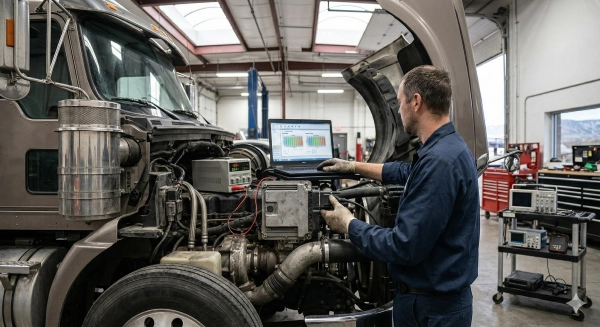
Selecting a performance ECM tuning partner lays the foundation for secure, reliable horsepower increases, stable uptime, and years of engine life. Seek indications of expertise in diagnostics, platform depth, and compliance. Then ensure the tools and workflow align with your fleet objectives across all duty cycles and climates.
Select a reputable, experienced shop like Coppertop Truck Repair that understands heavy-duty diagnostics and compliance.
Reputation comes from transparent diagnosis, not speculation. A skilled shop combines mechanical instinct with information from scan tools, oscilloscopes, cylinder pressure tests, and smoke/flow tests. That counts in heavy-duty work where emissions, aftertreatment, and load cycles are complicated. In the early 2000s, tuners relied heavily on mechanical ability. That baseline recognition still keeps misreads at bay today. Coppertop Truck Repair brings heavy-duty diagnostics and regulatory awareness, which prevents ‘bandaid’ fixes that can mask root faults. Ask for examples: DEF system derates solved with sensor rationality tests, VGT control tuned only after confirming actuator health, and torque modeling adjusted within manufacturer safety limits. Depth like this safeguards engines that go long hours under tow or at high gross mass.
Verify that your tuning partner uses advanced tuning technology and offers custom ECM solutions for your fleet.
Tools must be able to read, edit and log with high resolution, support checksum control and validate changes under load on a hub or chassis dyno. Today’s engines have turbocharging, direct injection and complex torque strategies, and your partner has to be able to safely map these. Custom files should be matched to axle ratios, tire sizes, altitude and duty cycle. For mixed fleets, look for breadth: diesel Class 8, light-duty pickups and even performance platforms like the Nissan RB show depth across spark, boost and fuel control. A prudent shop begins low, frequently around 15 psi on boosted builds, and then steps up while monitoring knock, EGT, lambda, rail pressure and smoke. That tempered approach cuts the 50% failure rates some tuners experience with hurried, high-boost rigs.
Ensure the shop prioritizes durability, uptime, and regulatory compliance in every tuning project.
A good tune strikes the right balance between power, drivability and reliability. Anticipate peak cylinder pressure caps, safe EGT targets, and torque shaping to safeguard gearboxes and clutches, such as AWD layouts that strain launches. Request pre-tune health checks, post-tune validation, and maintenance advice. Compliance counts everywhere, and a good partner keeps emission controls working and tuned.
Encourage Alberta fleet managers and owner-operators to consult Coppertop’s team for expert advice before modifying ECM settings.
Alberta roads, cold starts at around 0 °C and below, and long hauls require specialized torque, cold-start fueling and aftertreatment strategies. Coppertop can analyze duty cycles, examine run logs and suggest staged modifications that keep trucks running, not paused.
Conclusion
ECM tuning can increase power, dial in throttle, and reduce lag. Gains vary according to base map, fuel grade, and hardware health. A clean, well cared for car commands the best lift. A rusty car conceals hazard and deadens output. Real wins come from steady steps: log data, make small tweaks, and test on the road or a dyno.
Just to be safe, match tune to fuel, watch temps and track knock. Take notes with the maps. Have stock files on hand. For legality, see local laws and warranty conditions.
To jump smart, define specific objectives. Think part throttle pull, tow load, or track days. Then talk to a tuner, send some logs, request a baseline plan, and start mild.
Frequently Asked Questions
What is ECM tuning, and how does it work?
ECM tuning modifies your engine’s control module with new fuel, ignition, and boost maps. A tuner pulls the stock file, updates some important values, and then flashes the new map. This process allows us to maximize power, torque, and drivability within safe limits.
How much performance can I gain from ECM tuning?
Usual gains are 5 to 20 percent power on NA and 20 to 40 percent on forced induction engines. Results are engine, fuel, and hardware dependent. A dyno session and data logs give you the best possible estimate for your vehicle.
What are the main risks of ECM tuning?
Risks are knock, high exhaust temperatures, component life, and warranty. Bad maps can cause drivability issues. Aim for conservative targets, good cooling, and quality fuel. Always log and monitor after flashing a new tune.
Is ECM tuning legal in my region?
It’s conditional. Most areas do prohibit emissions-related alterations. Certain tunes may break your local laws or inspection standards. Know the rules before you tune. Demand emissions-compliant maps from your tuner and require them to provide test proofs and documentation to support local compliance.
What’s the difference between stock and aftermarket maps?
Stock maps are all about reliability, emissions, and fuel economy. Aftermarket maps aim for beefier performance and responsiveness. Good aftermarket maps maintain safety margins and adjust for fuel and climate. Make sure the map fits your engine, hardware, and application.
How do I choose a reputable tuning partner?
Search for proven experience, dyno facilities, a data-driven workflow, and transparent safety limits. Look at before and after logs, customer reviews, and warranty conditions. Inquire regarding support, updates, and return to stock alternatives. Ask for proof of emissions and reliability testing.
Do I need supporting mods for ECM tuning?
Most of the time, yes. High-flow intake, intercooler, and exhaust assist in controlling heat and airflow, particularly on turbo engines. Fresh spark plugs, premium fuel, and maintenance are important. Tune performance ECM tuning.
Looking for a reliable heavy-duty partner? See how Coppertop Truck Repair supports Edmonton fleets with advanced diagnostics and 24/7 mobile service.
Comprehensive Fleet Maintenance Solution
Mobile Truck and Trailer Repair in Edmonton
Want more insight into preventive fleet maintenance standards? Visit Transport Canada’s official site for national commercial vehicle safety information.
Heavy-Duty Vehicle & Engine Emission Regulations